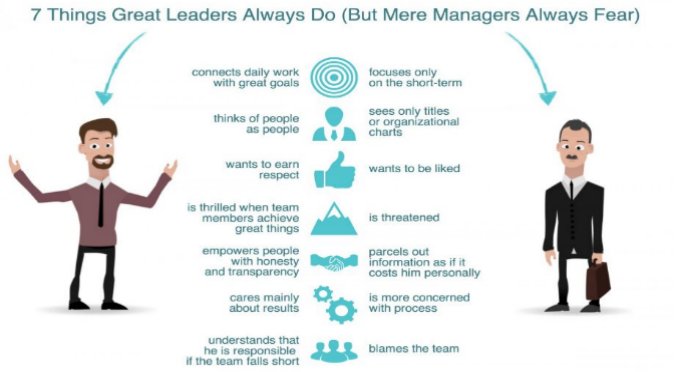
Managers manage, and leaders lead. Do managers automatically become leaders? What makes a manager become a true leader?
Firstly, there is a difference between managers and leaders. A manager commands and a leader inspires. I don’t think that a seasoned manager is automatically assumed to be a leader even if they might think so. I have been a subordinate to many managers/supervisors in my career as an accountant. Ranging from trainee to ultimately being a manager myself I have partially seen the breadth of range of many many managers. There were several distinctions between the styles of supervision I was under and I was cognisant of my own inner emotions during each of their reigns.
Strangely enough, the best and the worst manager I have ever encountered worked in the same company at the same department. How could this be? Was I predisposed to favouring one for the other? How could two individuals with such similar backgrounds, similar experience, similar ages, similar work functions be so very different in the way they manage their teams and their people. It was a difference in their approachability, their receptiveness, and their outlook on you. A manager believes you are a tool, amongst others to facilitate departmental objectives, a leader trusts that you are the vital key necessary for departmental success.
I list below the types I’ve encountered.
The Authoritarian:
This manager was single-handedly the worst manager I have ever worked for. He failed repeatedly to establish a tasks’ relevance. This is vitally important for me. Do not ask me to do something if you cannot unequivocally state its purpose. Answers such as “It was done this was last quarter”, “The auditors want it this way”, or “Chief Executive XYZ wants you to do it” are responses I immediately dismiss. The stark omission of the lacking WHY does not bode well for any established practice or process. Why do they want it? What do they do with it?
These questions reinforce corporate purpose and more importantly reaffirms my own relevance. They are the reason departments are set up in such manners. What if something was done incorrectly last year and you request me to repeat that process? Would it not stand to reason that it may potentially be done wrong this year as well? If you cannot articulate why something needs to be done clearly, then either as a manager, you fail at communication or worse still you yourself do not understand the things you do and wish to delegate this in the vain hope that your subordinate does. This is a recipe for poor management. Disastrous still is that as the subordinate plods along and presents report variant after variant whilst the manager keeps refining their requirements until something tangible sticks that the manager can ultimately deliver. This waste of effort keeps departments rooted in cyclical non-performance and reduces its agility and curbs enthusiasm.
The worst example I can give was a manager once asked me to prepare a value added statement for the auditors. The auditors in question were from a different firm to those that sign off on consolidated financial statements. I asked why do they need it, and the response was that they just sign these off. I asked if I could contact them to ask why they require this and was told to just go ahead and do the task without being obtuse. In the intervening three months the manager kept changing the required and asking for odd reconciliations and changed the initial format and depth of the report. When the report was completed, he filed it away. At year close, the unopened file was discarded in the dustbin. The auditors had not required this and therefore was of no further use. A lot of pain could have been avoided had the question been asked. It was obtuse not to do so.
The apocryphal leader:
An apocryphal leader is someone whose leadership authority or authenticity is doubted. This common archetype is often sighted in senior echelons of a corporation’s hierarchy. This type of leader originates through the passage of time. A junior clerk becomes a senior accountant who then after several years becomes a manager and few years later becomes senior manager and then progresses to director or vice president. The more subordinates and departments one commands the more one believes that he a true leader has become. And he very well might be a leader if he inspires those around him.
If he has to command his inner circle of lieutenants to perform his orders, if he maintains his inaccessibility to juniors, if he is arrogant or self-righteous or fails to be that beacon of hope and inspiration that marks true leaders, then guess what…..he is not a real leader.
His position of power does not come from within him, it comes from his status within the company. The business has conveyed a sense of importance upon him and he has erroneously believed that to be an election of his leadership. This is potentially catastrophic, as that person conducts himself with an air of leadership and not management (which he actually is). He stakes more at risk, as he believes that subordinates will push harder to satiate their “united” or “common” goals. His podium speeches are elaborate vision statements and not action orientated instructions. There is a tremendous vacuum that is created between his ideals and the subordinates’.
It is because I don’t believe him to be a leader. I don’t share his values, or his ideology. He hasn’t resonated with me on a deeper level for me to blindly follow him. And therefore, I truly don’t understand him. When he talks (as though he is a leader) I’m trying to unravel the complexity of what he actually wants. If we shared a belief, instructions would be simple to decipher, but when we don’t its much trickier.
This leader also desperately wants a follower. He tests the strength of his follower base with jokes sometimes and often, many a truth is spoken in jest. He might have a series of terrible jokes or absurd observations and those that laugh or nod in agreement get allocated their place in his minds’ eye. Those that question or rebut, are not deemed worthy followers. This is not someone to lead me. I do not idolize false Gods seeking worship. Make me believe in you. Show me that you have traits that rise above the ordinary, that your ideas are legendary, that you think differently but still connect humbly to people. That you will defend your principles and the people that echo it, despite adversity. That you do not seek out a follower base but rather, attract it surreptitiously.
There is a great example of this type of leader I once encountered. He would puff out his chest and swoon through the department looking for attention. Those that peered his way would be rewarded with a smile and a wink, and those that didn’t would be visited for cross examination later. He would send out department wide emails about “Branson’s top 10 leadership traits” or “10 Leadership behaviours” etc and next to each bulleted point, he would reply (in red) how he has or does said statement. In his conclusion it would read: “ I have given evidence of how I have these 10 characteristics and therefore consider myself to be a leader”. Even if he truly did have those qualities that make him a leader, his email advertising campaign lost him all credibility and authenticity as a leader for me.
The Leader:
In my opinion, a true leader does not leverage the job title; he is humble in his interactions with you, but firm in his disciplines. He guides and mentors you. He connects with you on such a level, that if he had to call you at midnight on Saturday and ask you to prepare a report, you will gladly do it. You do it because more than knowing, you faithfully believe it is right course of action. Without hesitation or doubt you are guided by a voice deep within you that feels and believes the words of this leader. How does this happen, how could someone external to you, different to you, connect and resonate with you at this level?
I really cannot give any one specific example of this leader as it profoundly permeated my psyche and value system. For me it was his attentive listening, his defence of my beliefs, his personal actions, his humility, his rewards and the uniqueness of his thinking.
First he would start by listening to who I am, attentively and without bias. He would highlight his similarities and expose differences in our personalities. He got to know me, what I like, what I dislike, my strengths and weaknesses. He would test me to see if my words corresponded to my actions/output and then plan tasks that suit my capabilities. By allocating jobs that corresponded to my strengths, success was the only option. Those made me feel great. And he would reward those successes, not with money but with things that he knew I liked. For example, he would buy me a beer if we delivered a report early. Sometimes his rewards were more tasks that he knew I might enjoy. Cyclically we started working harder and faster together, achieving greater successes together than individually.
Bigger jobs were divvied up so that even though I might not get the lions’ share, I knew I would get the lions’ praise. If there was a task that had to be done that didn’t suit me ideally, he would guide me and be available for soundboard discussions. He created the environment necessary for my growth. He never asked me to pander to the role but hammered the role to suit me. His trust in me kept extending until the lifeline was no longer needed and I could operate autonomously. Then his purpose changed to inspire through his actions. It’s not that he changed, but rather I did. He would continue doing what he did, and I slowly started seeing the best of me through him. I realized that this is who I wanted to be and all my actions were dedicated to achieving that goal. He no longer needed to ask; he and I both knew it would get done. I worked harder, more consistently, efficiently and smarter under his tutelage because I was given the freedom to do so. Any external restrictions on my capacity were fiercely defended and he fought harder than most to ensure I was acknowledged for my efforts (even if it meant he had to sacrifice his own comforts).
A good way to know if you are working for someone like this is to ask yourself: “Would you work for this person for free?” If you answer “yes” you are actually working for yourself and that is the hallmark of a truly inspirational leader.